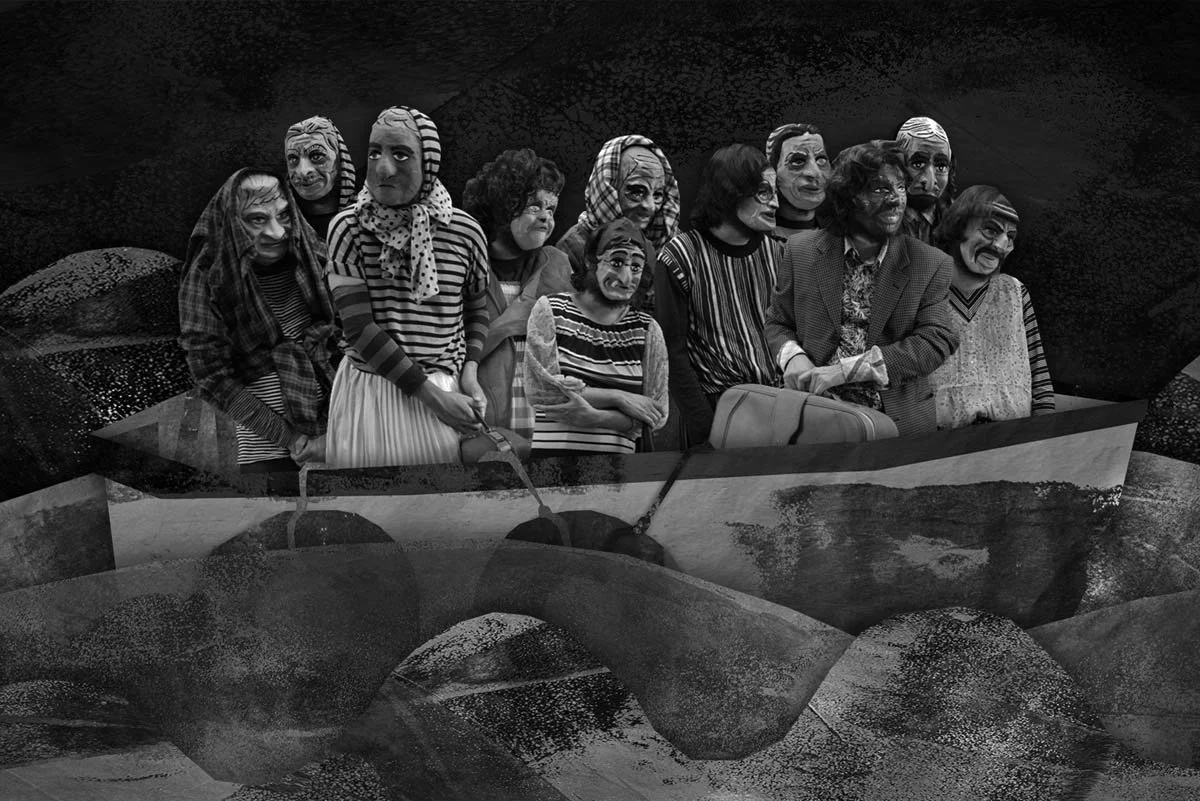
MARE MAGNVM, 2021
Edison Peñafiel (b. 1985, Guayaquil, Ecuador) is a Miami-based interdisciplinary artist whose immersive installations place the viewer inside the conditions of migration, power, and disappearance. Alongside them, he makes materially driven textile compositions that carry the same investigations into autonomous sculptural works.
In MARE MAGNVM, a twelve-channel video installation, 81 masked figures, nearly all performed by the artist, cross a projected sea. Presented at the University of South Florida Contemporary Art Museum and Sabrina Amrani Gallery, Madrid, it comes to Locust Projects, Miami, during Miami Art Week 2026. His next work, De Profundis Clamavi ad Astra, is in development with support from the VIA Art Fund and premieres at Locust Projects in summer 2027.
His work has been presented at the Ford Foundation Gallery, New York; The Ringling Museum, Sarasota; CA2M – Centro de Arte 2 de Mayo, Madrid; the Mint Museum, Charlotte; the Orlando Museum of Art; and the Contemporary Arts Center, New Orleans. International exhibitions include BIENALSUR at MUNTREF Museo de la Inmigración, Buenos Aires; the Trienal Poli/Gráfica de San Juan, Puerto Rico; and Passerelle Centre d’Art Contemporain, Brest, France.
He is the recipient of the Florida Prize in Contemporary Art, the Premio ARCO Comunidad de Madrid, the Knight Arts Challenge Award, the South Florida Cultural Consortium Fellowship (2019, 2026), the VIA Art Fund Artistic Production Grant, and the Foundation for Contemporary Arts Creative Research Grant. His work is held in public collections including CA2M, Madrid; The Ringling Museum, Sarasota; Lowe Art Museum, Coral Gables; Oolite Arts, Miami; and Elsewhere Museum, North Carolina.
He has participated in residencies at The Watermill Center, MASS MoCA, Anderson Ranch, and McColl Center for Art + Innovation. Peñafiel is represented by Sabrina Amrani, Madrid.
STATEMENT
Edison Peñafiel constructs immersive environments where migration, myth, and transformation are experienced as conditions of existence rather than historical events. Working with projection, sound, textile, and architectural form, his practice builds a continuous, self-governing system in which meaning emerges through immersion, duration, and the passage between states.
The work draws from converging philosophical frameworks: Andean cosmovision, Gnosticism, Hermeticism. These are not regional or doctrinal references but parallel grammars for how cultures structure descent, threshold, and emergence. In the Andean system, hanan pacha, kay pacha, and uku pacha are fluid states of existence, not fixed locations. His installations materialize these states spatially: environments the viewer must enter and navigate, where the boundary between water and light, history and myth, dissolution and return remains deliberately unstable.
MARE MAGNVM places 81 archetypal figures, masked, unlocatable, stripped of national identity, into perpetual migration across a projected sea. De Profundis Clamavi ad Astra descends into the oceanic underworld of that same system, where historical violence, mythological figures, and material transformation converge. Arcturus, a forthcoming work, extends that system into open space.
These works are not sequential chapters but interrelated spatial conditions: an expanding field where oceanic depth, stellar distance, and human displacement form one continuous structure of transformation and return.